





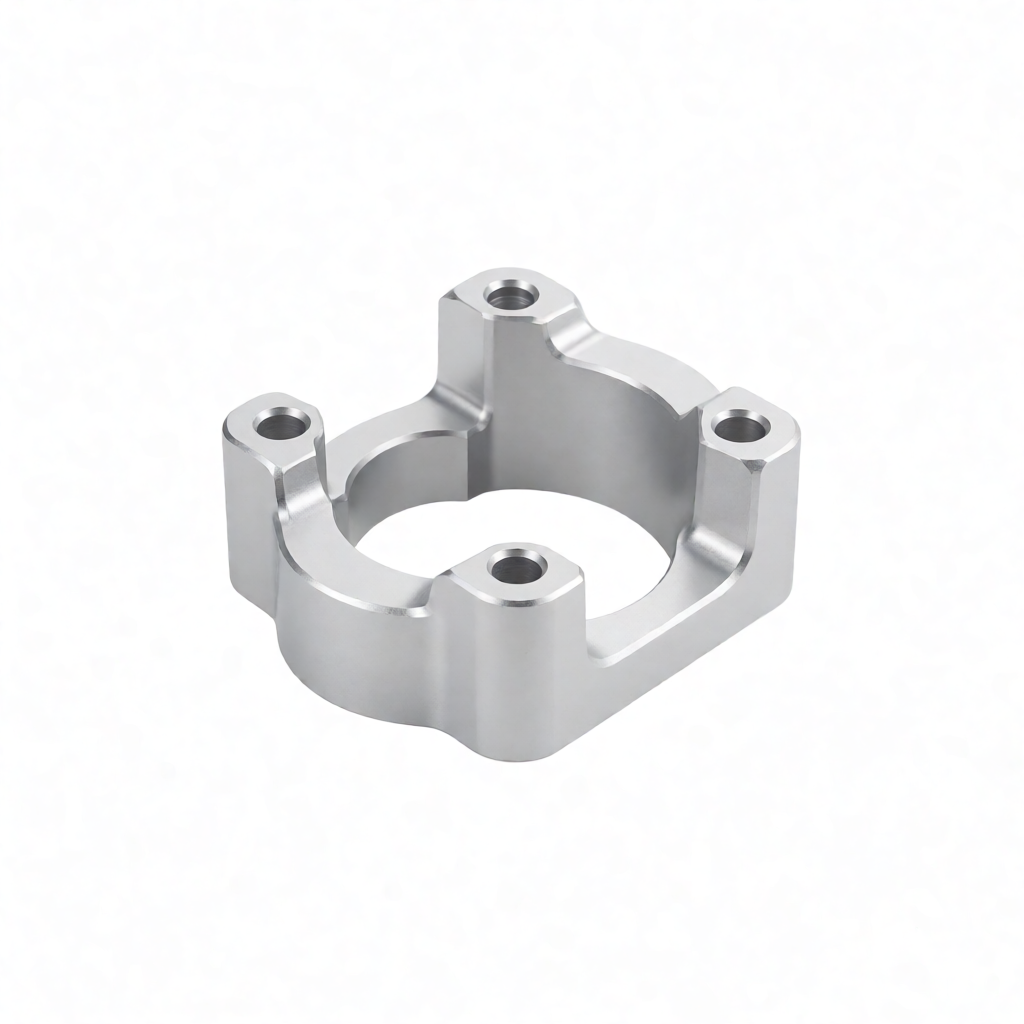
In the aerospace field, CNC parts design is undergoing a profound transformation from "trial and error based on experience" to "data-driven". For the lightweight topology optimization of aviation structural components, the core logic is not blind weight reduction, but rather to predict the stress distribution through simulation, eliminate redundant materials, and ensure that every gram of weight serves the structural integrity. This precision CNC parts customization processing model requires the manufacturing end to have extremely high multi-axis linkage capabilities and a deep understanding of materials science. For purchasing engineers and R&D personnel, understanding how the topologically optimized model is transformed into machinable entities is the key to evaluating the technical quality of suppliers. ShowyMetal offers 3-axis, 4-axis and 5-axis machining centers, CNC lathes, centerless lathes and turning and milling compound equipment, supporting a variety of materials such as aluminum, steel, stainless steel, brass and engineering plastics, with a tolerance of ±0.01mm and a surface finish of Ra0.4μm. This article will delve into the key points of full-process control from DFM (Design for Manufacturing) to mass production, helping you shorten the R&D cycle while ensuring the appearance quality and dimensional stability of mass delivery.
Engineering Logic and Topology Optimization Principles for Lightweighting of Aviation Structural components
Why do traditional weight reduction strategies fail in aviation structural components?
In traditional design, engineers often rely on safety factors for uniform wall thickness design. However, the forces on aviation structural components are complex, and there are obvious stress concentration areas and low-stress areas. Directly reducing the wall thickness will lead to a sudden drop in fatigue life, while topological optimization automatically distributes materials through algorithms, making the structure "look like" its force path. For lightweight materials such as aluminum alloys, this optimization can reduce the weight of parts by 20% to 40% while enhancing their rigidity. The key point is that the "skeletal" models generated through optimization are usually extremely complex, containing small cantilevers, deep cavities and irregular surfaces, which pose a great challenge to CNC machining.
The balance between Topology Optimization and CNC manufacturability
The model output by topology optimization must undergo DFM review. An overly thin cantilever structure may cause chatter during 5-axis milling, leading to tool breakage or excessive waviness on the part surface. The deep cavity structure may impede chip removal and cause tool burning. Therefore, during the optimization stage, the constraints of "minimum wall thickness" and "maximum depth-to-width ratio" need to be set. For instance, for 7075-T6 aluminum alloy, it is recommended that the minimum wall thickness be controlled at over 2mm and the depth-to-width ratio of the deep cavity not exceed 3:1. The engineering team of ShowyMetal will intervene before prototyping, provide DFM suggestions, modify difficult-to-machine features, and ensure that the design not only meets the lightweight goal but also ADAPTS to the characteristics of CNC processes.
Core material selection: Processing characteristics of aviation-grade aluminum and titanium alloys
Lightweighting is not limited to titanium alloys alone. Due to their high specific strength and mature processing system, aluminum alloys remain the preferred choice for most non-load-bearing main structures. Material selection directly determines cutting parameters, tool life and post-treatment plans.
| Material grade | Typical hardness (HB) | Cutting characteristics | Applicable scenarios | Difficulties in CNC Machining |
|---|---|---|---|---|
| 7075-T6 aluminum | 150-170 | Hard aluminum alloy, with high tensile strength, is prone to tool sticking. | High-stress beams, connecting ear pieces | Low-temperature cutting or coolant lubrication is required to prevent burrs. Residual stress needs to be stabilized by aging. |
| 6061-T6 aluminum | 95-115 | It has good comprehensive performance, excellent processability and low cost. | General structural components, shells, brackets | The surface is prone to oxidation and discoloration, and needs to be cleaned quickly. Poor heat dissipation leads to rapid wear of the blade tip. |
| TC4 titanium alloy | 330-350 | For 10,000 pieces, 3D printing (SLM/EBM) or casting can be considered, but CNC still has advantages in terms of precision and surface quality.



