

Robot seal material compression long-term deformation: why life depends
Under the background of rapid mass production of humanoid robots and collaborative robots, joint seal ringsCompression Set It is the core indicator to determine the seal failure cycle. The oil in the robot actuator presses the seal for a long time under high speed reciprocating motion and high temperature conditions. If the material is compressed for too long, insufficient rebound of the seal lip will lead to contact pressure attenuation, which will eventually lead to oil leakage or dust ingress. For engineers and purchasers, understandISO 815 orASTM D395 The deformation rate and life prediction model under test conditions are the premise of selecting key materials such as NBR, FKM (Viton) or TPU. Based on the experience of precision parts manufacturing and material testing, this paper combs the compression deformation law of robot seal ring in the temperature range of-20 ° C to 120°C, and discusses how to pass the test.5-axis precision turning and milling compound technology Optimize seal groove geometry to compensate for stress losses due to material aging, helping you lock in reliable sealing solutions during development.
Core Test Standards and Parameters: ISO 815 vs. ASTM D395
Different standards have slight differences in test conditions, mold size and measurement methods. Before directly comparing data, it is necessary to confirm the source of the standard. ISO 815 (heat aging compression long-term deformation) and ASTM D395 (normal temperature compression long-term deformation) are often used as benchmarks in the robot industry. The following are the key parameters of the two standards when testing common materials of robot seals:
| Compare Dimensions | ISO 815 (heat aging) | ASTM D395 (Ambient/Short Time) | Significance of robot selection |
|---|---|---|---|
| test temperature | 70°C / 100°C / 150°C (optional) | Usually 23 ° C or room temperature | ISO simulates high temperature aging, D395 simulates static initial installation |
| decrement | 25% ± 2% | 25% ± 2% | To match seal groove design compressibility |
| time | 22 hours/70 hours/22 days | 22 hours/22 days | The 70 hour range is suitable for evaluating rapid decay at high temperatures |
| recovery time | 3 minutes | 3 minutes | Insufficient recovery time will lead to rebound error, affecting accuracy |
In robot joint design, seal groove space is limited and usually allows15%-30% If the material is compressed for 70 hours at 70 ° C and the long-term deformation exceeds25%, seal after several thermal cycles may accumulate long-term deformation amount close to the total compression amount, resulting in free state size larger than the groove width, resulting in installation interference or excessive stress and tear. Therefore, compression long-term deformation (70 ° C, 70 h) is recommended.≤ 20% fluororubber (FKM) or highly filled nitrile rubber (NBR).
Material selection: Analysis of deformation characteristics of NBR, FKM and TPU
The molecular structure of different polymer systems determines their resistance to long-term deformation. For robotic sealing applications, oil resistance, temperature resistance and resilience are trade-offs:
- Nitrile butadiene rubber (NBR): Excellent oil resistance and low cost. However, at high temperatures (>80°C), the molecular chain is prone to irreversible deformation. 70°C/70h compression long-term deformation is usually25%-35%. Suitable for low temperature, light load grease seal.
- Viton/Viton: Molecular skeleton contains fluorine, high temperature resistance (150°C+) and high compression deformation resistance. 70°C/70h compression long-term deformation can be controlled10%-15%. It is the first choice for high temperature sealing of robot servo motor and reducer.
- Thermoplastic polyurethane (TPU): High hardness, wear resistance, but poor oil resistance. If used in dry friction or grease lubrication conditions, pay attention to solvent corrosion caused by swelling deformation. Compression resilience depends on crystallinity, easy to soften at high temperature.
For precision pilot seals requiring high resilience, considerHNBR (hydrogenated nitrile)Its compression long-term deformation performance is close to EPDM, but it has the oil resistance of NBR, and the deformation rate at 70°C/70h can be as low as15%-20%。
Seal groove geometry optimization: compensation for distortion with precision CNC
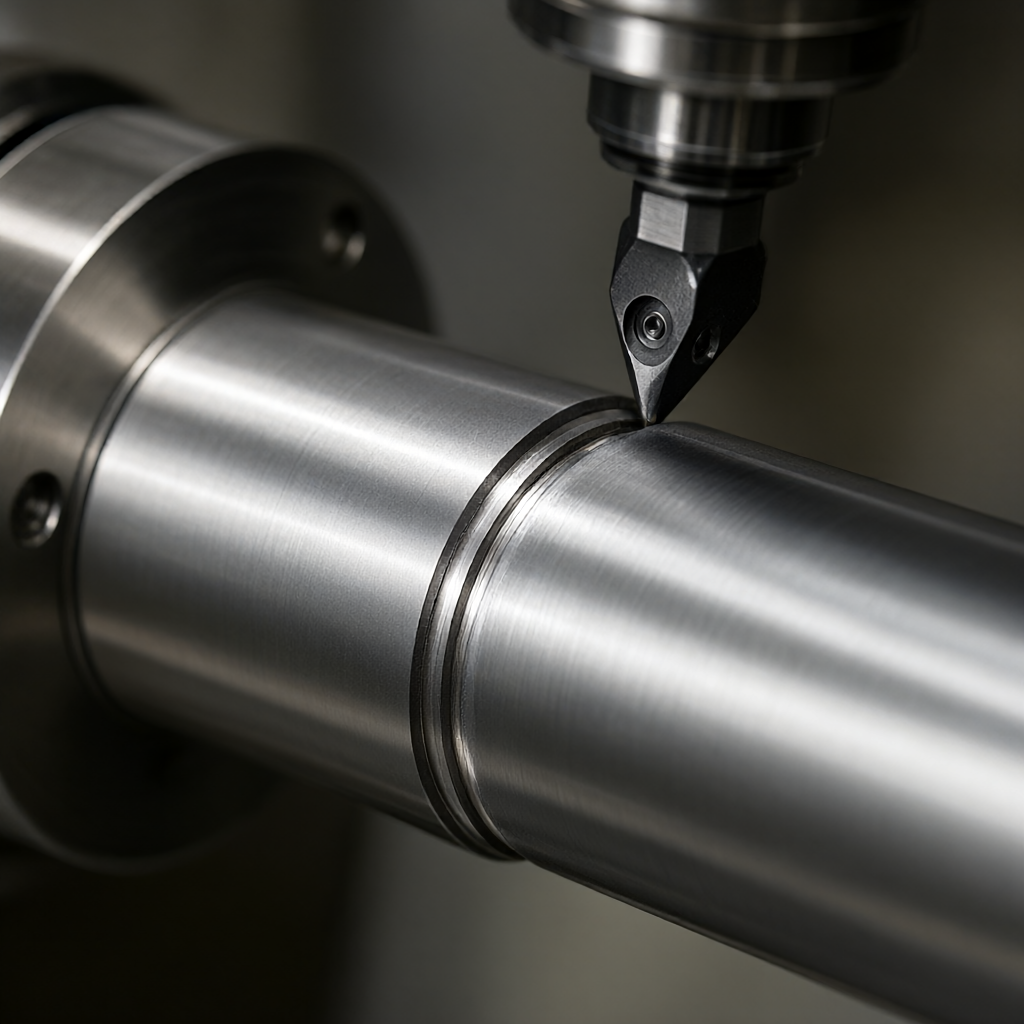
The seal ring is not only an elastomer, but also a precision mechanical part.5-Axis CNC Milling oroff-center turning When machining metal seal grooves, allowance for material deformation must be reserved. ShowyMetal uses a high precision CNC lathe (up to±0.01mm) processing robot shell sealing groove, surface finishRa0.4μm, in order to reduce the friction damage when installation.
The following compensation principles shall be followed in the design:
- Slot width calculation: The groove width $W$should be equal to the outer diameter of the seal ring section + the total compression $c$. If the material compression long-term deformation rate is $P$, then the effective compression $c_{eff} = c - (P \times d)$, where $d$is the section diameter. Ensure that $c_{eff} > 15\%$maintains the seal.
- Chamfer design: The notch chamfer radius $r$should be larger than the lip radius of the seal ring to avoid stress concentration. In CNC milling, the tool path should consider the tool diameter to ensure that the chamfer has no tool mark.
- Surface Texture: for dynamic seal, that sealing surface may be fine longitudinal grain (wire drawing process Or diamond knife), guide the oil film reflux, reduce dry grinding. Roughness control inRa0.8-1.6μm Between.
Through DFM (Design for Manufacturability) audit, engineers can verify the fit clearance between seal groove and seal ring at the prototyping stage.72 CNC machines ensures15-25 days Complete the delivery of the robot shell and its sealing structure in order to ensure the consistency of the sealing groove size between batches.
Common Failure Modes and Avoidances
Robot seal failure is often not sudden, but gradual. Combined with test data, there are three main failure modes:
1. Insufficient contact pressure due to prolonged deformation
Phenomenon: After 6 months of operation, trace leakage occurred.Reason: The long-term deformation rate of material compression exceeds the standard, or the compression amount during installation is less than 20%.Avoidance: Select FKM or HNBR; optimize the groove width design to ensure that the compression ratio after installation is in the range of 25%-30%; increase the number of sealing lips (double lip seal).
2. Swelling leading to seizure or crush failure
Phenomena: Seal ring diameter enlarged, difficult to install, or stuck in operation.Reason: Lubricating medium incompatible with material (e.g. NBR contacts synthetic oil other than mineral oil).Avoidance: ASTM D706 volume change test was performed to confirm the swelling ratio< 10%; material that matches the media (e.g. PTFE or FKM).
3. Dynamic wear and scratches
Phenomena: Grooves on the surface of the seal ring, dust ingress.Reason: Sealing surface roughness is too high (> Ra3.2) or hard sealing surface has burrs.Avoidance: Controlling the Roughness of the Sealing Surface after CNC Machining≤ Ra0.8μm; Use before installationsand blast orpolishing Treat the seal groove surface; select the seal with self-lubricating coating.
Test Method and Acceptance Criteria
To ensure the long-term reliability of the robotic seals, a full-chain inspection system from material to finished product is required. ShowyMetal is equipped withCoordinate Measuring Machine (CMM) withoptical projector, the seal groove and seal ring size for full size test.
- Material Testing: Commissioned by a third party or laboratoryISO 815 Compressive long-term deformation test, the report shall include the deformation curve at different temperatures/times.
- size acceptance: Inner and outer diameters and thickness of sealing ring shall be in accordance withISO 3601-1 Acceptance of tolerance zone; width and depth of sealing groove shall be in accordance with the drawing±0.01mm Check and accept.
- Visual Inspection: 100% visually free from scratches, bubbles, and impurities. For high gloss metal housings, make surescratch-freeThe surface of the anodic oxidation or electroplating layer.
- Assembly Test: Simulate the full travel of the robot and check for leaks and coefficient of friction. If usedinjection molding ormetal plate Process of sealing shell, need to pay special attention to the influence of welding deformation on the sealing surface, increase when necessarylaser trimming the process.
FAQ: Selection and Processing of Robot Seal Rings
How much compression is recommended for robotic joint seals?
Recommended compression for static seals15%-25%, Dynamic Rotary Seal Recommendations20%-30%If the compression is too low, leakage will occur; if the compression is too high, the friction will be large and the wear will be accelerated. For details, the effective compression shall be calculated in combination with the long-term compression deformation rate of the material.
How do you decide which is more suitable for high temperature robots, NBR or FKM?
If the operating temperature exceeds80°C, it is strongly recommended that you useFKM (Viton Rubber). NBR at high temperature long-term deformation acceleration, significantly shorten the life. FKM, although the cost is high, but the compression deformation rate is low, more suitable for high temperature servo motor.
What is the surface roughness requirement for CNC machined seal grooves?
typically requireRa0.4-1.6μm. Too thick will wear seals, too thin will leave no oil storage space. For high-gloss trim or precision mating surfaces, ShowyMetal can do thisRa0.4μm and ensure batch consistency.
What are the benefits of applying grease when installing seals?
Reduce installation friction, prevent seal ring twisting or intrusion into gaps; replenish initial oil film, protect seal lip. However, make sure grease is compatible with material (does not swell).
What is included in the one-stop service for mass production of seals and shells?
Includes DFM recommendations, CNC machining of metal shells, injection molding/die casting of non-standard seal rings, surface treatment (anodizing/plating), and incoming and outgoing inspection. ShowyMetal can provide15-25 days batch delivery cycle.
Conclusions and recommendations for action
The reliability of robot seals depends on the matching of the long-term compression deformation performance of the material with the precise geometry of the seal groove. Engineers should select the type according toISO 815 The data evaluates the aging characteristics of the material and reserves sufficient compression allowance. In the manufacturing process, select a material withHigh precision CNC machining ability andStrict appearance control suppliers are critical. ShowyMetal72 CNC machines with±0.01mm Precision control, combination70°C/70h compression long-term deformation Test data to customize highly reliable robotic sealing solutions.
If you are developing the next generation of robot products, welcome to send your seal structure drawings and operating parameters (temperature, medium, motion frequency), our engineering team will be inwithin 24 hours Provide DFM recommendations and material selection options.